Arsenal Football Club is an English professional football club located in Holloway, North London. It plays in the English Premier League and is one of the top four clubs in England. He won the English Premier League title 13 times, the FA Cup 14 times, and once the European Cup Winners’ Cup, which was later changed to the European Union Cup.
The club was founded in 1886 under the name “Dial Square” by a group of workers who were working on the railway known as “Underground”, but it was not long before it changed shortly afterwards to become “Royal Arsenal”. 10 years after its founding, the team moved to the professional world in 1896, when, by royal orders from the Government of Great Britain, its name was changed to “Woolwich Arsenal”, but the team’s supporters did not like the name very much, as they deleted the clip The first to become only Arsenal. Which means arsenal in the Arabic language, and it was officially adopted, and it is the name currently in force. The club became the first southern member of the Football League in 1893, and began playing its matches in the second division before qualifying for the first division in 1904. The relative geographical isolation of the club caused a lower percentage of viewers of its matches than that of other clubs, which made it sink in problems Finance and officially declares bankruptcy in the year 1910, that is, in the same year in which it was bought by businessmen Henry Norris and William Hall. Norris, after buying the club, resolved to move its geographical location elsewhere, and in 1913, after it was relegated to the Second Division, Arsenal moved to a new stadium in Highbury, north London; They gave up the name Woolwich the following year. Arsenal came fifth among the English teams in 1919, but despite this was re-listed in the First Division at the expense of arch rival Tottenham Hotspur, and it was rumored that this was done by dubious methods.
The club appointed Herbert Chapman as head coach in 1925. Chapman had won the League Championship twice with Huddersfield Town during the 1923–24 and 1924–25 seasons, bringing Arsenal to a gigantic renaissance that is today the first major success in the club’s history. Chapman’s training and revolutionary tactics, along with talented players such as Alex James and Cliff Bastine, laid the foundations for the club’s dominance of English football during the 1930s.
Tournament period edit
The real boom period for Arsenal was in the thirties of the twentieth century when Arsenal won five Premier League titles and two Cups in just nine years under the leadership of club president Herbert Chapman. The club won their first title in the 1930 FA Cup Final, followed by winning the League twice in the 1930–31 and 1932–33 seasons. In addition, Chapman sought to change the name of the local London Underground station from “Gillespie Road” to “Arsenal”, making it the only underground station named after a football club. Chapman died of pneumonia at the beginning of 1934. He was succeeded by Joey Shaw and George Allison, and under their care the club won three new titles, in the 1933-34, 1934-35 and 1937-38 seasons respectively, and the 1936 FA Cup. The Arsenal star took a dip in something Gradually at the end of the thirties, that is, during the period in which a number of key players retired, and then the Second World War broke out, all football matches in the country were suspended, and the activity of all sports clubs stopped.
The team fasted from championships until the late forties and the beginning of the fifties, when the team won two league championships and an English Cup championship. In the post-war period, Tom Whitaker succeeded George Allison as coach, winning the League Championship in 1947-48 and 1952-53, and the FA Cup in 1950. But the club’s fortunes dwindled after that, as it was unable to attract players of the same caliber as its players The thirties, so he spent most of the next two decades without achieving any title, and the former England team captain, Billy Wright, when he took over the club, could not achieve any success with him, so his stagnation continued from 1962 until 1966.
The seventies and eighties[e
The year 1970 was a special year for Arsenal as, after beating Anderlecht 4-3, they won the first unofficial European championship in its history, the Inter-Cities Fairs Cup, which was merged with the European Cup later. This victory was followed by another big win, which was winning the League and Federation Cup at the same time, in the 1970-71 season. Bad luck followed Arsenal in 1978, 1979 and 1980 as they qualified for the FA Cup final three times in a row but lost all of them. The team achieved only one success during this period, a last-minute victory over Manchester United 3–2 in the 1979 FA Cup Final, a match often considered a classic by fans.
Former team player George Graham returned to the club in 1986, this time as coach, and his coming opened a third flourishing period in Arsenal’s history, winning the League Cup in the 1986-87 season, Graham’s first season, and this victory followed another League title in a season 1988–89. 1989 was a year that fans of the English Premier League in general and Arsenal and Liverpool fans in particular did not forget, and the reason for that is that Liverpool were three points ahead of Arsenal and three goals ahead of Arsenal until the last game, and the last game in the league brought them together at Anfield Road, Liverpool’s stronghold. Arsenal must win by two goals if they want to win the English title, while Liverpool is enough to draw and even defeat with a goal to win the title, but Arsenal managed to win two to nothing in the Liverpool stronghold and in front of its fans to snatch the league title by one goal and in a dramatic way that English stadiums have not seen, and more than The excitement that Arsenal’s second goal came in lost time in the second half and in the 94th minute by Michael Thomas, who later became a Liverpool player.
Nineties period edit
In 1991, Arsenal won the league again, but this time it was decided from the start, tweeting outside the flock, as he conceded only 18 goals in 38 games, which is the lowest rate of interference against a team in the history of the English Premier League. In 1993, Arsenal re-entered history, becoming the first English club to combine the FA Cup and the League Cup. Not only that, but he also won the European Cup Winners’ Cup in 1994 after defeating Parma, Italy, with a goal scored by Alan Smith.[19][28] Graham’s reputation was tarnished after it was proven that he had received commissions from the Norwegian sports agent “Ron Hoge” in exchange for giving up some players, and he was dismissed from his position in 1995, and Bruce Reutch succeeded him for one season before leaving the club due to a dispute with the board of directors.]
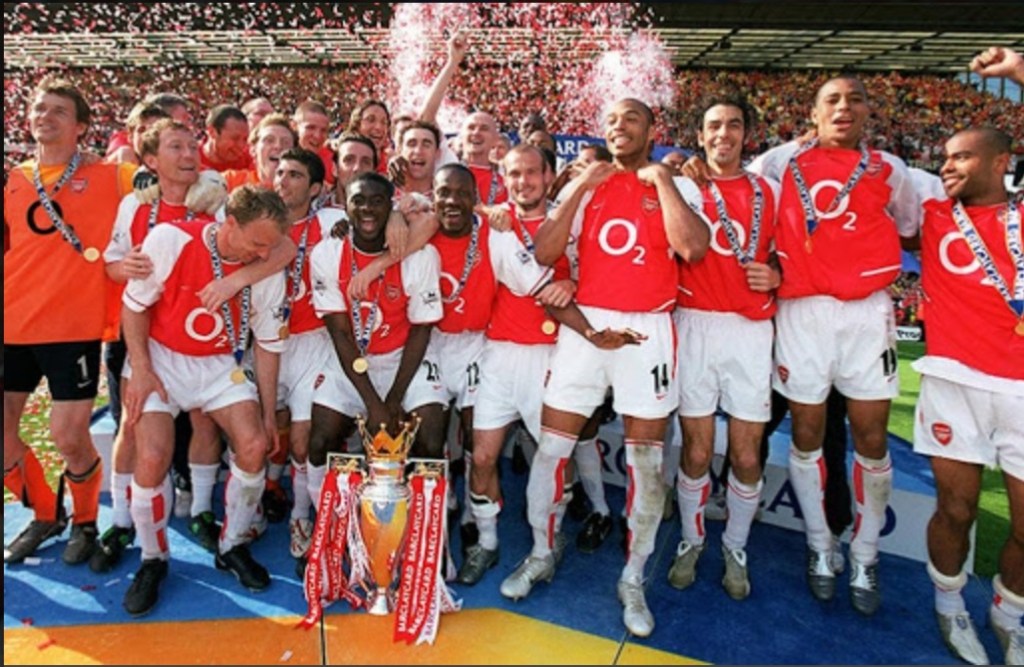
The club’s success in the last years of the 20th century and 2000s can be attributed to the appointment of Arsene Wenger as coach in 1996. The latter introduced new playing tactics, introduced a modern training system, and brought in a number of foreign players who complemented the existing English talent. In the 1998 season, Arsenal combined the league and cup championships for the second time in its history, after it was 13 points behind in the middle of the league from leaders Manchester United, to return and win the league four rounds before its end. He also did not concede any goal in twelve consecutive matches, that is, in one thousand eighty minutes (1080 minutes). In 1999, Arsenal lost the league in a dramatic way, by one point, and also got out of the quarter-finals of the cup due to Dennis Bergkamp missing a penalty kick in lost time.
This is just a simple thing from the history of the great Arsenal club, they have many trophies and fans who love the club who stand with him through thick and thin and will always do so, historical players including one of the greatest strikers, Thierry Henry, they also had a very great and capable coach who led them to the best periods of the club with him. A great club that always deserves the best and we hope to see it again at the top.
 football guys